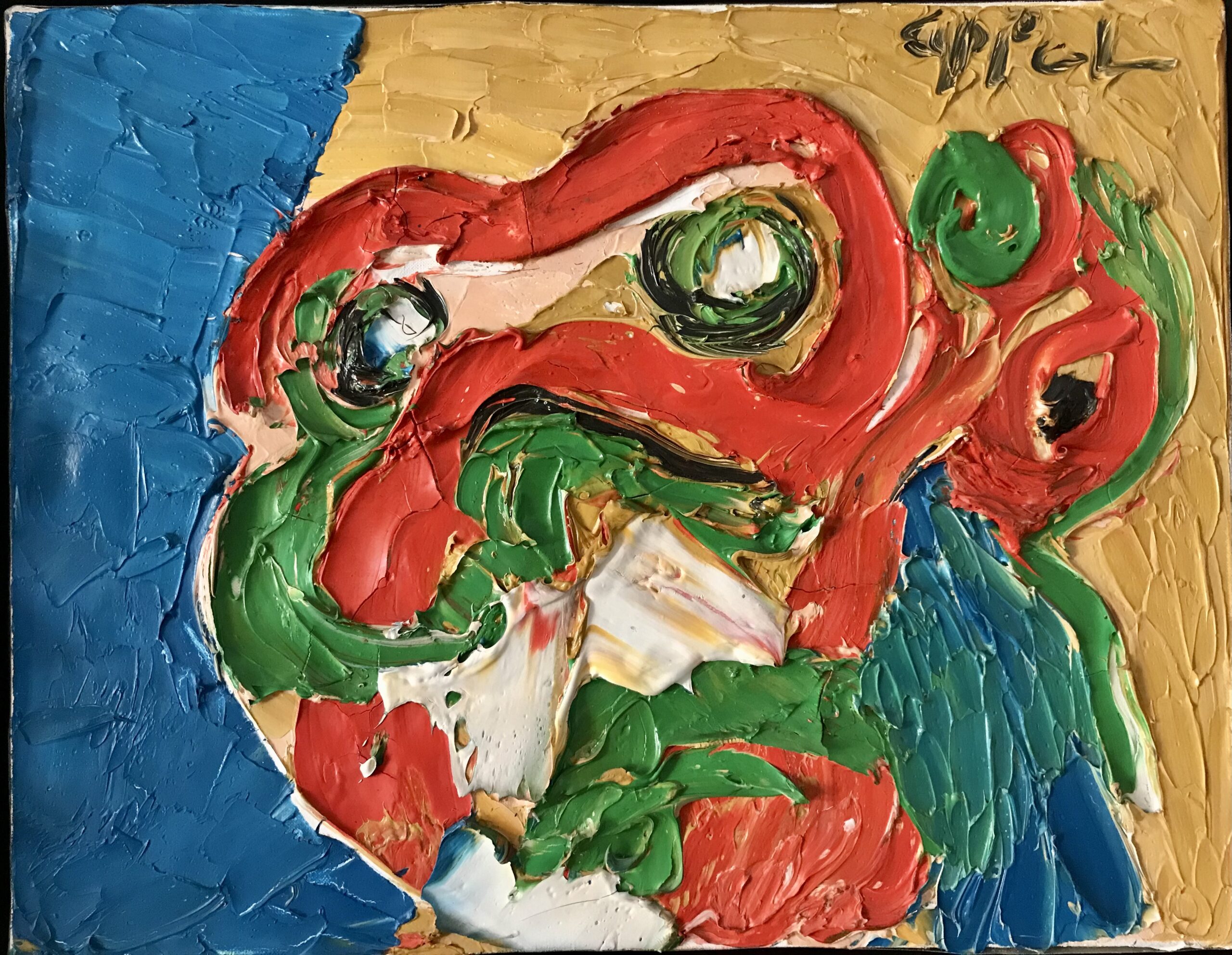
Karel Appel: CoBrA artist and expressive force
Karel Appel, a Dutch painter, sculptor, and ceramist, studied at the Academy of Fine Arts in Amsterdam and quickly became one of the key figures of the CoBrA movement. Coming from a working-class background, Karel Appel stood out as a rebellious force and became one of the most iconic representatives of CoBrA.
Karel Appel and artistic freedom
Karel Appel sought freedom in every aspect of life, especially in his art. In the late 1940s, Karel Appel developed his imaginative depictions of humans, animals, and other creatures, often featuring grotesque expressions, oversized heads, and wide-open eyes. Breaking away from academic constraints, Karel Appel painted with pure colors and simple forms. His goal was to avoid the consciousness of adulthood in his work, drawing inspiration from children’s drawings for their spontaneity and naivety.
The creative energy of Karel Appel
Karel Appel felt a constant need to express himself and usually allowed his moods to determine the content of a particular work, the execution itself almost becoming like a physical liberation for him. These free, undisciplined actions during the artistic creation process were absolutely fundamental to Karel Appel.
Karel Appel between Paris and New York
Appel exhibited in Paris (Studio Paul Facchetti) and later also in New York (Martha Jackson Gallery) in 1954. New York was a place which particularly inspired him.
The late style of Karel Appel
Appel often used a very pasty painting style in his later career, whereby he always remained faithful to the CoBrA principles. His art is characterised by a raw power which continues to fascinate art collectors right across the world.